

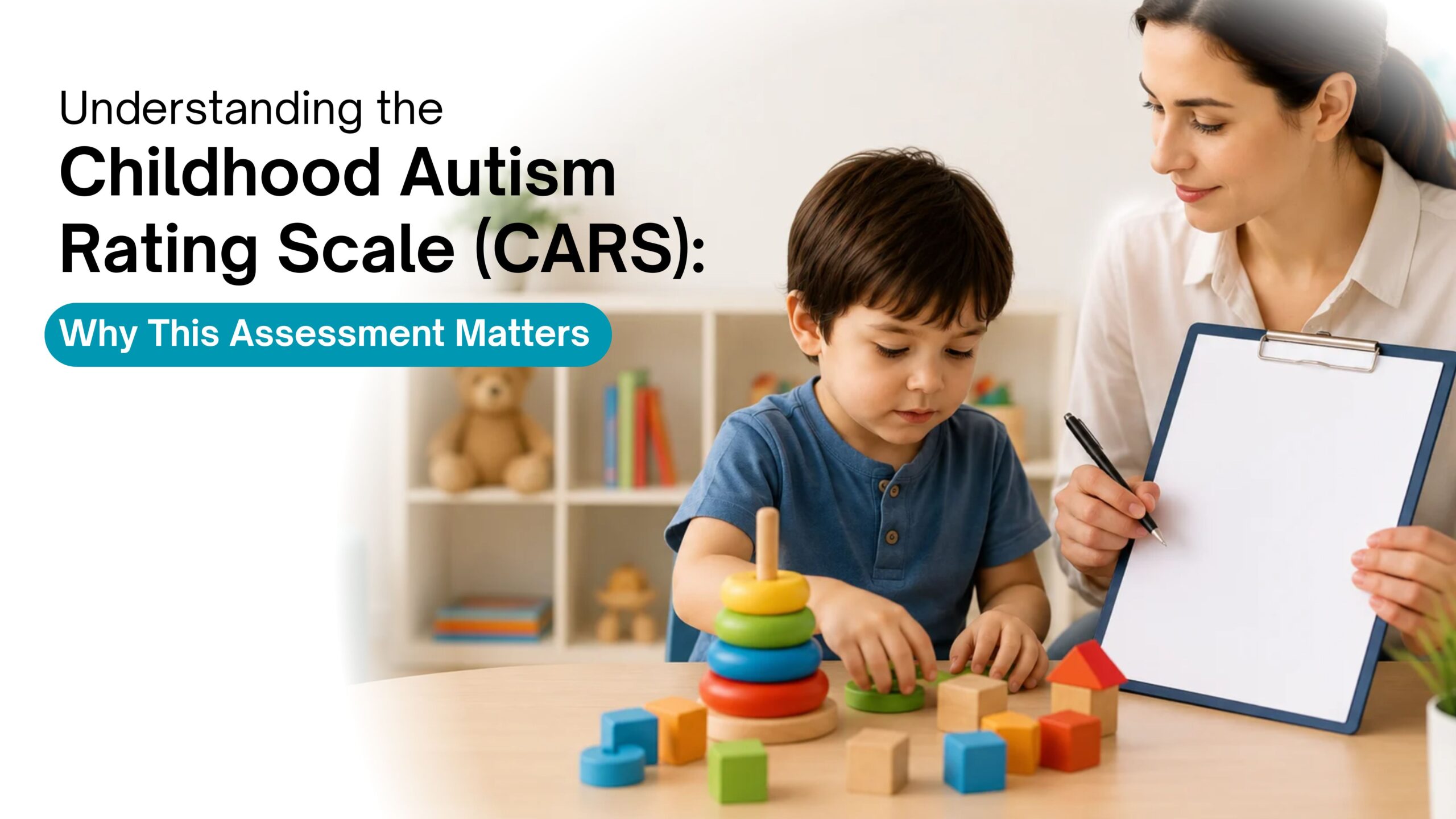
Autism assessment is much more than arriving at a diagnosis. It helps professionals understand how a child communicates, interacts socially, responds to sensory experiences, and functions in daily life.
One of the most widely used tools for evaluating autism is the Childhood Autism Rating Scale (CARS).
For decades, CARS has helped clinicians across the world identify autism characteristics and determine their severity. Its structured approach provides valuable insights that support individualized intervention plans and long term developmental outcomes.
The Childhood Autism Rating Scale (CARS) is a behavior based assessment tool designed to identify autism and evaluate the severity of symptoms. Developed by psychologist Eric Schopler and colleagues, CARS combines direct observation with information gathered from parents, caregivers, and teachers.
The assessment consists of 15 areas of behavior that examine:
Each area is rated on a scale from 1 to 4, with higher scores indicating more pronounced characteristics associated with autism.
CARS has remained one of the most trusted and extensively researched autism assessment instruments worldwide.
Rather than relying on a single symptom or observation, CARS evaluates a child’s behavior across multiple developmental domains.
Evaluates the child’s ability to interact with others, maintain eye contact, and engage in social situations.
Assesses both verbal and non verbal communication patterns.
Observes how the child expresses emotions and reacts to different situations.
Measures how well the child copes with transitions, routines, and unexpected changes.
Examines responses to sounds, textures, smells, touch, and visual stimuli.
Looks for repetitive movements, restricted interests, or repeated activities.
Together, these observations provide clinicians with a comprehensive understanding of a child’s strengths and developmental challenges.
Understanding these areas allows professionals to create personalized intervention plans rather than applying generalized therapies. Since every child with autism is unique, CARS helps tailor support to individual needs.
The total CARS score ranges from 15 to 60.
Behavior is generally considered within the non autistic range.
Indicates characteristics consistent with mild to moderate autism.
Suggests more severe autism characteristics.
These scores are not simply labels. Instead, they help professionals understand the level of support a child may require.
Children with mild autism may benefit from:
Children with moderate autism may require:
Children with more severe autism often benefit from:
Severity ratings help professionals and families:
The assessment can also be repeated periodically to monitor improvement and adjust interventions as needed.
Research consistently shows that early identification and intervention lead to better developmental outcomes for children with autism.
CARS helps professionals recognize autism characteristics even when symptoms are subtle or overlap with other developmental conditions.
Early assessment allows families to begin appropriate interventions sooner.
Improves communication skills and expressive language abilities.
Supports sensory processing, motor skills, and daily living activities.
Helps strengthen social skills, adaptive behaviors, and learning.
Equips families with practical strategies to support development at home.
Ensures appropriate classroom accommodations and individualized learning support.
A CARS assessment is not about placing limits on a child. It helps families better understand their child’s unique developmental profile.
A CARS evaluation can help families:
✔ Understand the specific challenges their child is experiencing.
✔ Identify therapies that are most likely to benefit their child.
✔ Support learning, communication, and social development.
✔ Track developmental progress over time.
✔ Begin intervention during the period when the brain is most responsive to learning and change.
Early support can significantly improve communication, independence, social participation, and overall quality of life.
CARS is typically conducted by qualified professionals such as:
The assessment generally takes 15 to 30 minutes, although interviews with parents, caregivers, and additional observations may extend the overall evaluation.
The Childhood Autism Rating Scale (CARS) has become one of the most trusted tools in autism assessment because it goes beyond identifying autism and helps determine the level of support a child may need.
Receiving a CARS evaluation is not about assigning a label. It is about gaining clarity, understanding a child’s unique strengths and challenges, and ensuring timely access to interventions that can make a lasting difference in development and overall well being.

© Inspiring Path Ways. All Rights Reserved
What are some early signs of autism that parents in Bangalore should look for?
Autism symptoms can vary, but some early signs include difficulty with eye contact, delayed speech, repetitive behaviors like hand-flapping, and challenges in social interactions. Some children may also be sensitive to sounds, textures, or bright lights. If you notice these signs in your child, it’s best to consult an autism specialist. Inspiring Pathways can connect you with leading doctors and therapists in Bangalore to guide you through the next steps.
Where can I find autism treatment centers in Bangalore?
Bangalore has several well-equipped autism centers, therapy clinics, and hospitals that provide behavioral therapy, speech therapy, occupational therapy, and special education programs. Inspiring Pathways helps parents find the right specialists and therapists near them based on their child’s needs. Simply get in touch with us at +919164062455, and we’ll guide you through the process.
Are there support groups for parents of autistic children in Bangalore?
Yes, Bangalore has several autism support groups where parents can connect, share experiences, and seek guidance. Some active groups include Parent Support Groups at NIMHANS, the Autism Society of India (based in Bangalore), and various online communities on WhatsApp and Facebook. Moreover, Inspiring Pathways can also help parents identify and join the right support networks, whether in-person or online, to make their journey easier and more informed.
How can I access reliable information about autism in Bangalore?
Parents can attend workshops and awareness programs held by organizations like NIMHANS, Autism Society of India, and local therapy centers. Additionally, trusted hospitals and therapy clinics in Bangalore frequently host sessions on autism awareness. Inspiring Pathways provides curated resources and connects parents with experts who offer accurate and practical guidance.
Where can I find good schools for children with autism in Bangalore?
Bangalore has several inclusive schools and special education centers that cater to children with autism. Many institutions offer specialized programs, therapy support, and individualized learning plans to help children thrive. Additionally, some mainstream schools provide special education support to ensure a more inclusive learning environment. Inspiring Pathways can assist you in exploring school options and connect you with the best doctors and specialists who best suit your child’s needs, helping you make an informed decision for their education and overall holistic development.
Is autism caused by bad parenting? Did I do something wrong?
No, autism is not caused by parenting style or personal actions. It is a neurodevelopmental condition influenced by genetic and environmental factors. Many parents in Bangalore go through feelings of guilt and self-doubt, but it’s important to focus on early intervention and therapy rather than self-blame. Inspiring Pathways provides emotional and practical support to help you navigate this journey.
Can autism be cured with alternative therapies like homeopathy or Ayurveda?
Currently, there is no scientific evidence that autism can be cured by homeopathy, Ayurveda, or stem cell treatments. The most effective interventions focus on improving communication, social skills, and overall development through therapies such as Applied Behavior Analysis (ABA), Speech and Occupational Therapy, Special Education, and Sensory Integration. Inspiring Pathways ensures that parents in Bangalore have access to evidence-based therapies and helps them make informed decisions about their child’s care.
How can Inspiring Pathways help parents in Bangalore?
At Inspiring Pathways, we know how overwhelming it can be for parents to find the right care and support for their child with autism. That’s why we are here—to guide you through this journey with compassion and expertise. We connect families with top autism specialists, therapists, and support groups in Bangalore, ensuring access to the best resources. From finding autism-friendly schools and therapy centers to offering guidance on early intervention and daily challenges, we are committed to making this path easier for you. No matter where you are in your journey, Inspiring Pathways is here to support you every step of the way. We are just a call away. Ring us now at 9164062455 for more information.
Online consultation speech, speech therapy, oral placement therapy and sensory integration, special educators, Vocational training centres, Assisted living communities, Disability certificate, Assessment, Will format, Financial planning, Nirmaya health insurance, Swavalamban insurance, UDID, Autism, ADHD, Cerebral palsy, Downs syndrome, Shadow teacher training, Preschool teacher training, NIOS, OBE level A, B,C, Parenting counselling, Parent child program, Structured teaching

