

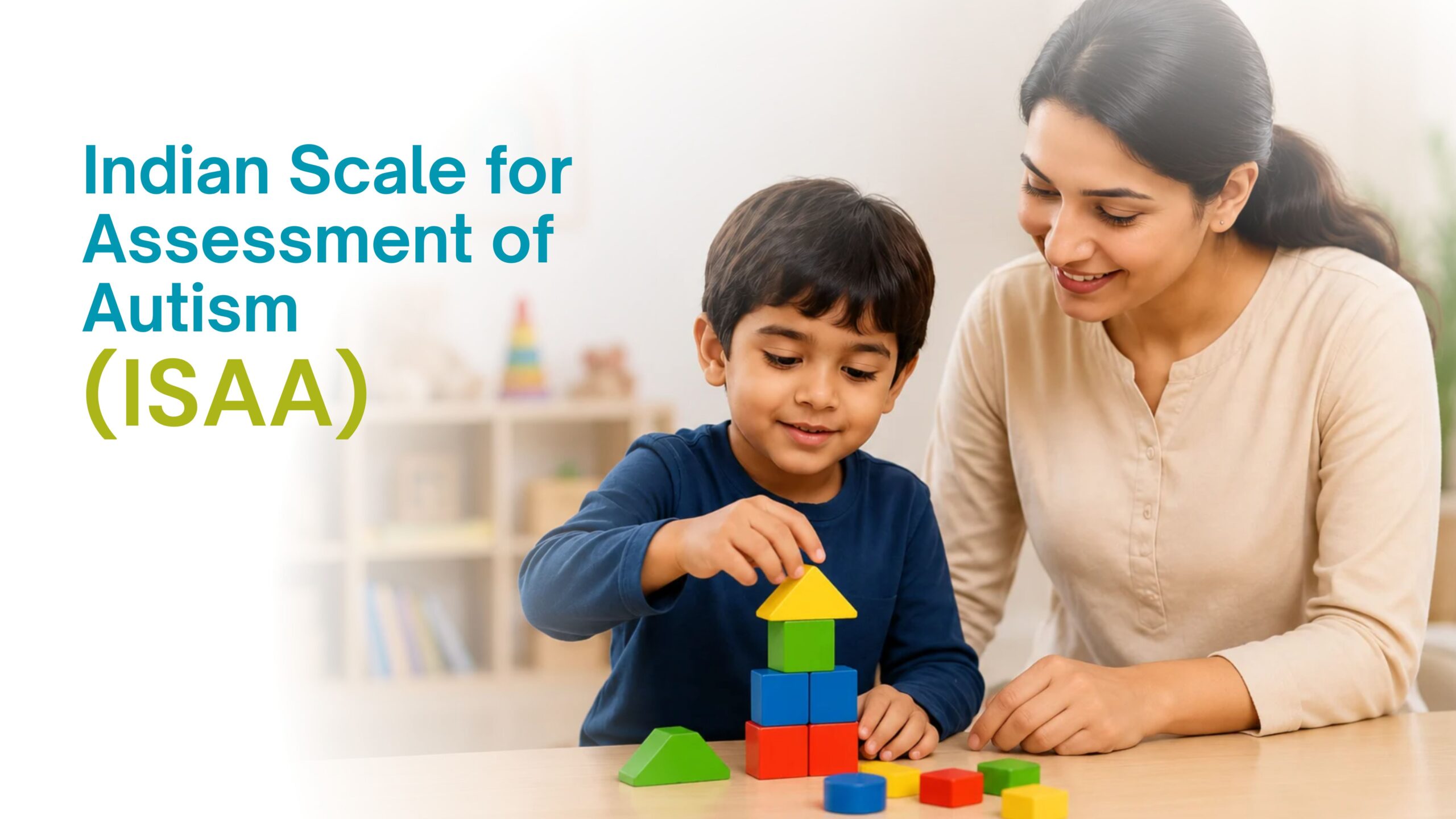
The Indian Scale for Assessment of Autism (ISAA) is a 40-item clinician-rated assessment tool developed in India to evaluate the severity of autism and determine disability in children and young adults.
It uses structured observation and caregiver interviews across six developmental domains:
ISAA scores range from 40 to 200.
Not Autism
Mild Autism
Moderate Autism
Severe Autism
The assessment usually takes 15 to 20 minutes, requires minimal specialized training, and is available free of cost in multiple Indian languages.
Studies have shown excellent reliability and validity with high internal consistency (Cronbach’s Alpha approximately 0.93 to 0.97). However, it is less accurate for children below five years of age and may not clearly distinguish autism from other neurodevelopmental disorders such as ADHD or intellectual disability.
Autism Spectrum Disorder (ASD) is a neurodevelopmental condition characterized by:
Early assessment is essential for timely intervention.
The Indian Scale for Assessment of Autism (ISAA) was developed by the National Institute for the Empowerment of Persons with Intellectual Disabilities (formerly NIMH) specifically for Indian populations.
Unlike many international assessments, ISAA is:
The assessment combines:
Each of the 40 items is scored on a scale of 1 to 5, producing a total score between 40 and 200.
The ISAA was designed to:
Under the Rights of Persons with Disabilities (RPWD) Act, autism is recognized as a disability.
ISAA scores are also converted into disability percentages for government certification.
ISAA has been validated for individuals aged 3 to 20 years.
It can be used across varying intellectual abilities, including children with coexisting intellectual disability.
However, research suggests:
Therefore, clinicians interpret results cautiously in younger children.
The assessment is conducted by trained professionals such as:
The clinician observes the child’s:
Parents answer questions regarding their child’s:
Each of the 40 items receives a score from:
1 = Rarely or Never
5 = Always
The complete assessment generally requires 15 to 20 minutes.
The total score ranges from 40 to 200.
Does not meet autism criteria.
Mild Autism.
Moderate Autism.
Severe Autism.
Higher scores indicate greater severity.
ISAA results should always be interpreted alongside clinical judgment and additional assessments.
Research has demonstrated strong psychometric performance.
Studies report:
ISAA has shown:
Receiver Operating Characteristic (ROC) analysis has demonstrated excellent diagnostic accuracy.
Despite being developed specifically for the Indian population, ISAA offers several advantages.
Developed specifically for Indian children and available in multiple regional languages.
Usually completed within 15 to 20 minutes.
Available without licensing fees through the National Trust.
ISAA evaluates:
Validated across Indian clinical populations.
Officially accepted for disability certification.
Despite its advantages, ISAA has several limitations.
Less effective for toddlers and preschool children below five years.
Children with:
may receive elevated scores despite not having autism.
Children with subtle social communication difficulties may receive lower scores than expected.
Internationally, assessments such as ADOS-2 and ADI-R remain the gold standard for autism diagnosis.
ISAA should always be used alongside a comprehensive clinical evaluation.
ISAA was designed specifically for Indian healthcare settings.
Its advantages include:
Many government hospitals and autism centers use ISAA for official assessments.
ISAA helps clinicians:
Families can use ISAA reports for:
Parent notices developmental concerns.
⬇️
Primary evaluation by a Pediatrician or General Practitioner.
⬇️
Referral to a Developmental Pediatrician, Psychiatrist, or Child Psychologist.
⬇️
ISAA Assessment.
⬇️
Interpretation of Scores.
⬇️
Diagnosis.
⬇️
Therapy Planning and Disability Certification.
Approximately 15 to 20 minutes.
The ISAA itself is free.
Families only pay the consultation fee charged by the evaluating professional.
Children may benefit from periodic reassessment to monitor progress.
Approximately 3 to 20 years, although caution is advised for children younger than five years.
A trained:
| Score | Interpretation |
|---|---|
| Below 70 | No Autism |
| 70 to 106 | Mild Autism |
| 107 to 153 | Moderate Autism |
| Above 153 | Severe Autism |
Yes. ISAA is officially recognized in India and is widely used for disability certification under the RPWD Act.
| Feature | ISAA | CARS | ADOS-2 |
|---|---|---|---|
| Purpose | Assesses autism severity and disability. Used for diagnosis support and disability certification in India. | Identifies autism and measures severity. | Gold standard diagnostic assessment for Autism Spectrum Disorder. |
| Age Range | 3 to 20 years | 2 years to adulthood | Toddlers to adults |
| Administration Time | 15 to 20 minutes | Around 15 minutes | 40 to 60 minutes |
| Cost | Free | Paid | Expensive |
| Training Required | Minimal | Moderate | Extensive |
| Best Used For | Disability certification and assessment in India | Clinical autism severity assessment | Comprehensive autism diagnosis |
| Strengths | Free, culturally appropriate, quick | Well researched and widely validated | Highest diagnostic accuracy worldwide |
| Limitations | Less accurate in younger children and high-functioning autism | More dependent on clinician observation | Time consuming, expensive, specialized training required |
© Inspiring Path Ways. All Rights Reserved
What are some early signs of autism that parents in Bangalore should look for?
Autism symptoms can vary, but some early signs include difficulty with eye contact, delayed speech, repetitive behaviors like hand-flapping, and challenges in social interactions. Some children may also be sensitive to sounds, textures, or bright lights. If you notice these signs in your child, it’s best to consult an autism specialist. Inspiring Pathways can connect you with leading doctors and therapists in Bangalore to guide you through the next steps.
Where can I find autism treatment centers in Bangalore?
Bangalore has several well-equipped autism centers, therapy clinics, and hospitals that provide behavioral therapy, speech therapy, occupational therapy, and special education programs. Inspiring Pathways helps parents find the right specialists and therapists near them based on their child’s needs. Simply get in touch with us at +919164062455, and we’ll guide you through the process.
Are there support groups for parents of autistic children in Bangalore?
Yes, Bangalore has several autism support groups where parents can connect, share experiences, and seek guidance. Some active groups include Parent Support Groups at NIMHANS, the Autism Society of India (based in Bangalore), and various online communities on WhatsApp and Facebook. Moreover, Inspiring Pathways can also help parents identify and join the right support networks, whether in-person or online, to make their journey easier and more informed.
How can I access reliable information about autism in Bangalore?
Parents can attend workshops and awareness programs held by organizations like NIMHANS, Autism Society of India, and local therapy centers. Additionally, trusted hospitals and therapy clinics in Bangalore frequently host sessions on autism awareness. Inspiring Pathways provides curated resources and connects parents with experts who offer accurate and practical guidance.
Where can I find good schools for children with autism in Bangalore?
Bangalore has several inclusive schools and special education centers that cater to children with autism. Many institutions offer specialized programs, therapy support, and individualized learning plans to help children thrive. Additionally, some mainstream schools provide special education support to ensure a more inclusive learning environment. Inspiring Pathways can assist you in exploring school options and connect you with the best doctors and specialists who best suit your child’s needs, helping you make an informed decision for their education and overall holistic development.
Is autism caused by bad parenting? Did I do something wrong?
No, autism is not caused by parenting style or personal actions. It is a neurodevelopmental condition influenced by genetic and environmental factors. Many parents in Bangalore go through feelings of guilt and self-doubt, but it’s important to focus on early intervention and therapy rather than self-blame. Inspiring Pathways provides emotional and practical support to help you navigate this journey.
Can autism be cured with alternative therapies like homeopathy or Ayurveda?
Currently, there is no scientific evidence that autism can be cured by homeopathy, Ayurveda, or stem cell treatments. The most effective interventions focus on improving communication, social skills, and overall development through therapies such as Applied Behavior Analysis (ABA), Speech and Occupational Therapy, Special Education, and Sensory Integration. Inspiring Pathways ensures that parents in Bangalore have access to evidence-based therapies and helps them make informed decisions about their child’s care.
How can Inspiring Pathways help parents in Bangalore?
At Inspiring Pathways, we know how overwhelming it can be for parents to find the right care and support for their child with autism. That’s why we are here—to guide you through this journey with compassion and expertise. We connect families with top autism specialists, therapists, and support groups in Bangalore, ensuring access to the best resources. From finding autism-friendly schools and therapy centers to offering guidance on early intervention and daily challenges, we are committed to making this path easier for you. No matter where you are in your journey, Inspiring Pathways is here to support you every step of the way. We are just a call away. Ring us now at 9164062455 for more information.
Online consultation speech, speech therapy, oral placement therapy and sensory integration, special educators, Vocational training centres, Assisted living communities, Disability certificate, Assessment, Will format, Financial planning, Nirmaya health insurance, Swavalamban insurance, UDID, Autism, ADHD, Cerebral palsy, Downs syndrome, Shadow teacher training, Preschool teacher training, NIOS, OBE level A, B,C, Parenting counselling, Parent child program, Structured teaching

